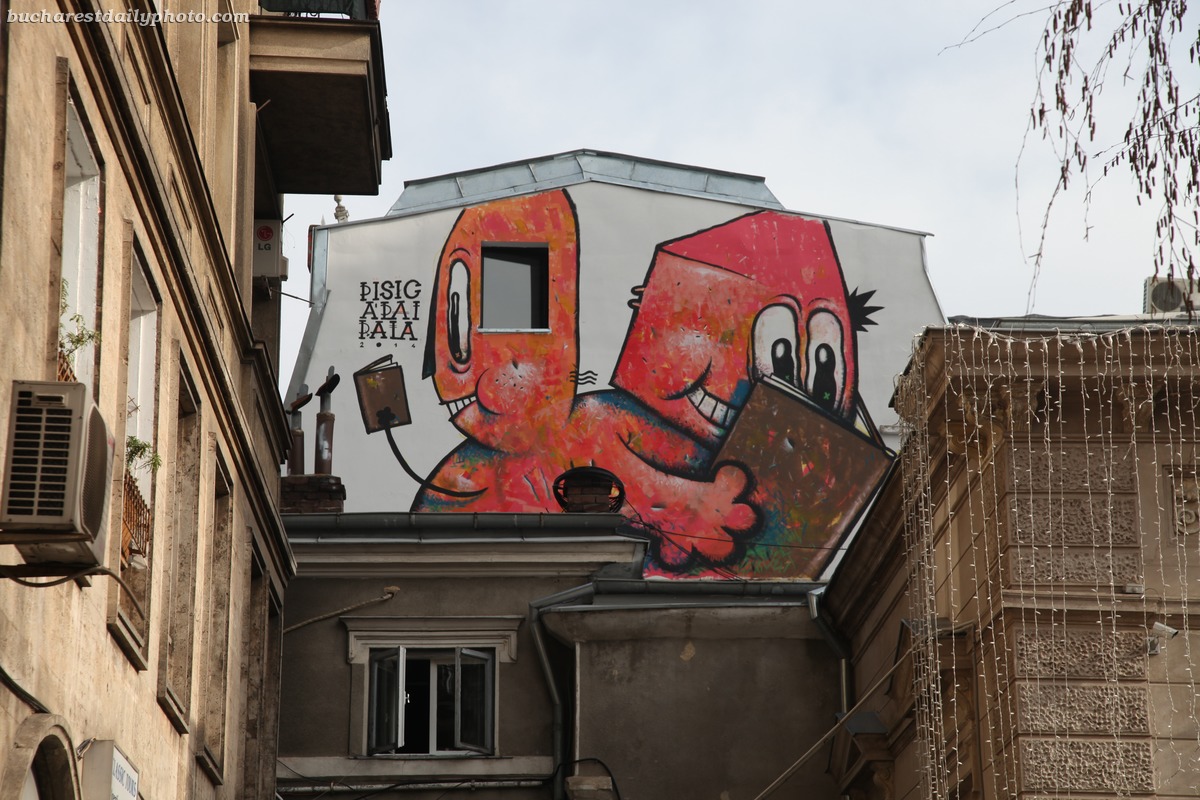
Today’s photo shows the upper floor of a run down house on Franceză Street, one of the streets in the Old Town that’s already been repaved. Unfortunately, the buildings that line the street are dilapidated and in great need of repairs. Despite their decaying air, I personally really love them. I believe that through all that tired look you can discern their former elegance.
For the next two weeks I’ll be blogging from abroad. I do plan on having uninterrupted service, so please continue to stop by.
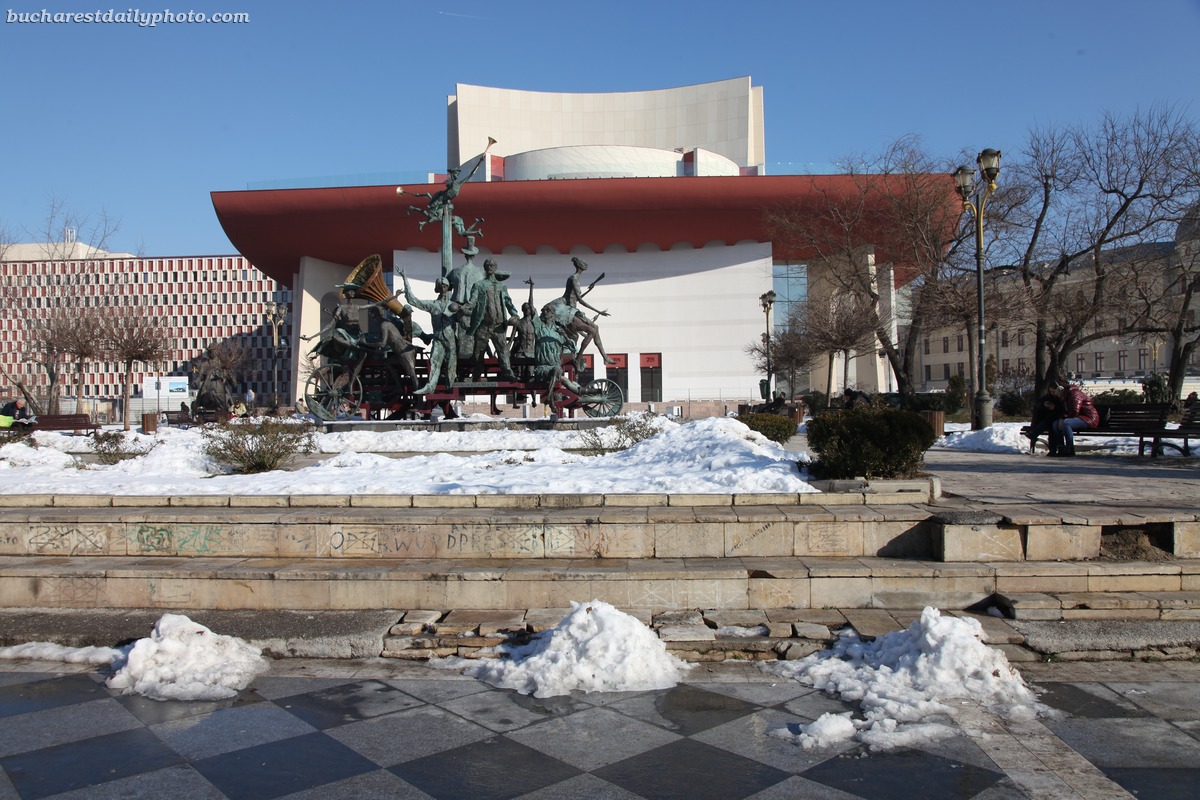
In my earlier post about Bucharest’s National Theatre I’ve talked about its facade being remodeled in 1984, which lead to the version which can be seen in today’s photograph. The theatre is scheduled to undergo renovation soon and if everything works as planned in two years we will admire a new facade, similar to the 1973 version!
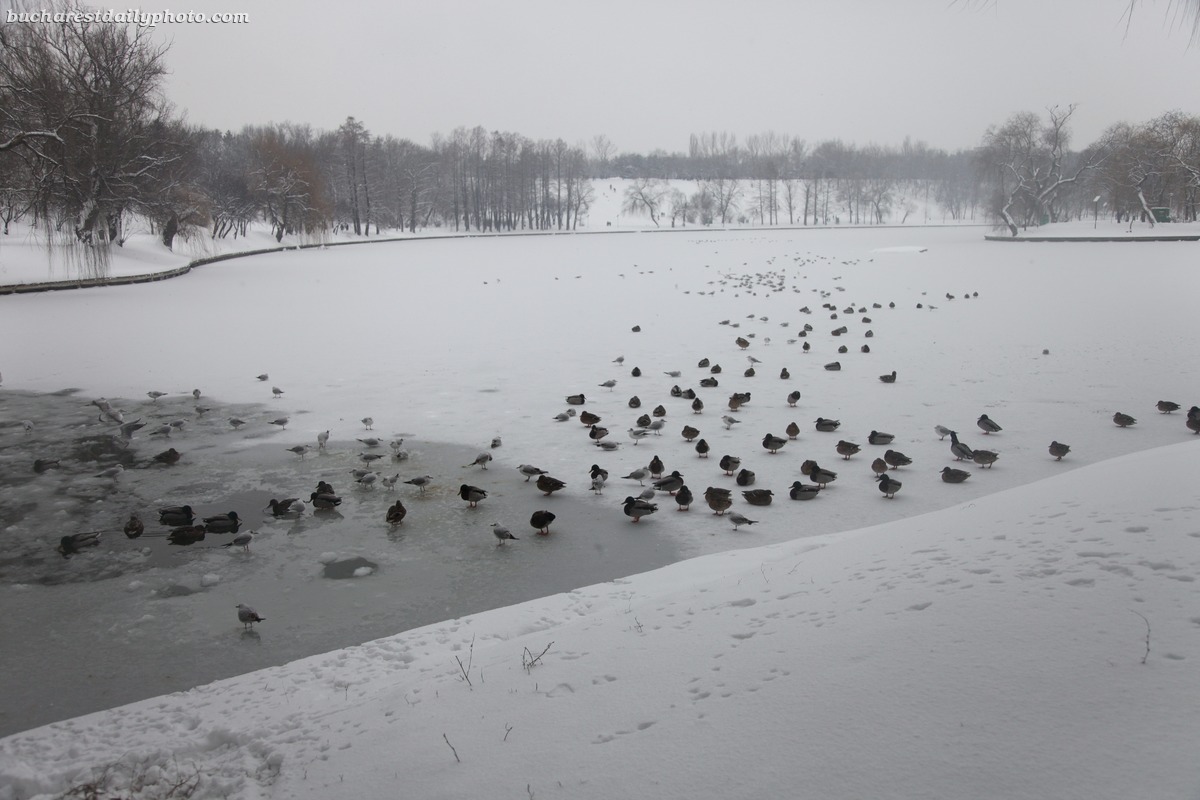
I woke up yesterday morning, March 11, to discover that it was snowing heavily outside. I don’t think there’s anyone out there to deny that this winter was a rather harsh one. Usually, at the beginning of March, Bucharest enjoys a warmer weather, with a bit of sun. Well, not this year. Climate change anyone?
By today the snow has turned to rain and whatever gathered on the ground turned into a disagreeable slush.
Today, the City Daily Photo blogging community pays tribute to Eric Tenin of Paris Daily Photo. Five years ago, on March 11th 2005, Eric started his daily photo blog of Paris and he’s been blogging ever since without missing one day. It was his blog that I found last summer while researching for a trip to Paris, and that inspired me to create this photo blog of my home city. To celebrate his 5th anniversary and honor Eric, the suggestion for today’s theme was to use one of his photographic techniques, be it the placing of the camera on the ground to make an image, or of skewing/tilting the composition. Click here to view thumbnails for all participants
The photograph shows the building which now holds the National Library of Romania and which before 1955 used to be the Palace of Stock Exchange. It was built in French Neoclassical style, between the years 1906 and 1911, after plans by architect Ştefan Burcuş.
As you can see above, the house in today’s photo has quite an unusual roof. It was the house of Alexandru Dimitriu (1871-1955) a skillful metalworker who between 1900 and 1940 built and designed a number of metallic roofs and cupolas in Bucharest. His works can still be admired today at the Romanian Atheneum, the Northern Train Station, the Palace of Patriarchy, the District 1 City Hall (which also has an armored knight atop its tower), the nowadays National Library, the Silvestru Church, to name a few. The armored knight that he placed on the roof of his own house holds a hammer in one hand, a mark of the owner’s trade. I think it looks quite unusual.
Another day, another celebration
This one is called Mucenicii in Romanian, which translates as the Martyrs of Sebaste. It’s a religious holiday, celebrating the martyrdom of 40 Roman soldiers who confessed their believe in the Christian faith and were condemned to be left naked into an ice covered pond near the city of Sebaste in Armenia, on a cold winter night, so they might freeze to death. The way we celebrate this in Romania is with a feast day, by preparing a special dish in the honor of the martyrs. It’s the only time of year I get to eat this dish and even if it’s not much, not a very sophisticated affair, I really like it. The dish bears the name of the celebration – “mucenici” – and can be prepared in two ways. The ones shown in the photograph above are the kind we prepare in the south of Romania. The dish consists of pieces of dough shaped as number 8 which we boil in water, adding sugar, cinnamon, ground walnuts and a bit of rum. In the northeast of Romania, in Moldova, they bake the dough and glaze it with honey and walnuts and you can see the result in the picture below. They’re quite yummy and I can’t wait to eat them today. I’ll have to excuse myself for the quality of the photos. They’re from my archives and back when I took them I thought I was taking them for myself so I didn’t pay too much attention to framing or setting up the scene.
Not a very inspiring photo but I couldn’t think of anything else for this subject. On March 8th we celebrate International Women’ Day, another occasion for men to express their love for the women in their lives. Wikipedia has a very interesting page on this subject. They describe Women’s Day being celebrated in Eastern Europe as a mixture between Mother’s Day and St. Valentine’s Day. I think that’s a very good description. Most men just buy flowers for the women close to them or for the women they know they’re going to meet on March 8th and a gift for the wife/girlfriend. As this follows very close to Mărţisor celebration I have to say that March must be the best month for a Romanian florist.
I’ve talked before about Cişmigiu Park, one of my favorite places in Bucharest. It’s a lovely park where I always find something to photograph. In my previous posts about Cişmigiu – which can be found under the namesake tag – I’ve showed you some of its landmarks. Today I’m adding two more photos to this collection, both of the same statue, called The Black Woman ( “Negresa” in Romanian, bearing no offensive connotation). I’m guessing it is called like that because of its color, because the subject doesn’t really have the features of a black woman. In one of my books on Bucharest I’ve seen it called “The Nymph of the Lake” but I didn’t hear anyone using this name.
A Trabby painted with scary faces and the like, which looks not to have been taken out of its parking spot in a while.
Versiune în română
After two weeks of somewhat warmer temperatures and a trace of the sun shining through, someone up there decided that the citizens of Bucharest have behaved badly and need to be punished. As if the grey sky and the rain weren’t enough, today we got ourselves a bit of sleet.